
Exothermic Molding Innovates with Poly-DCPD Polymer for Superior Results
When Exothermic Molding decided to launch into an alternative material, it required a commitment...
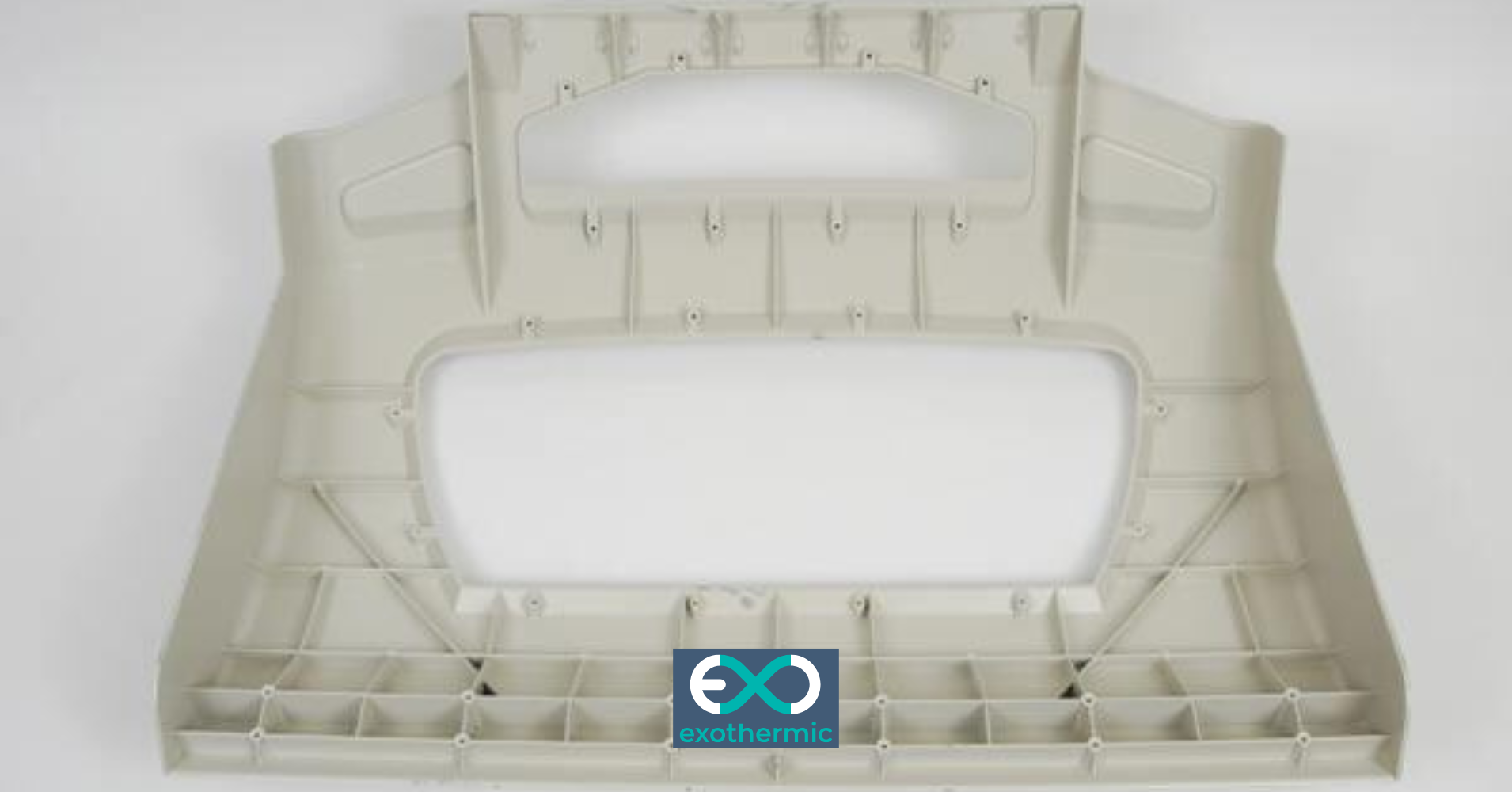
Most parts we quote could be molded in either polyurethane or Poly-DCPD. The choice usually comes down to four questions: how hard does the part get hit, what is it sitting in, how cold does it get, and how much can it weigh.
Quick Answer: Specify Poly-DCPD when the part has to survive impact, chemical contact, or weather. It is a thermoset built by ring-opening metathesis polymerization (ROMP), the chemistry recognized with the 2005 Nobel Prize in Chemistry. A Poly-DCPD part comes out 7-10% lighter than the same part in urethane or epoxy, and Extremis Systems testing puts its service range at -100°F to 250°F. Polyurethane is still the right answer when you need a soft durometer, a foam core, or a tuned density.
Poly-DCPD starts as dicyclopentadiene, a thin liquid monomer. A Grubbs-type ruthenium catalyst opens the strained ring and stitches the pieces into one continuous cross-linked network inside the mold. That is the metathesis chemistry Yves Chauvin, Robert Grubbs, and Richard Schrock shared the 2005 Nobel Prize for developing.
The practical consequence shows up on the shop floor. The monomer is about as thin as water going in, so it wets out deep ribs and long flow paths at low pressure. Then it cures into a network you cannot melt back down. We covered the processing side, and the cost comparison against thermoplastics, in how Poly-DCPD is processed and whether it is more economical than injection molding.
DCPD itself is a C5 fraction pulled off naphtha crackers, a co-product of ethylene production. It is a commodity feedstock with broad availability.
The cross-linked network absorbs energy by deforming instead of fracturing. Hit a Poly-DCPD panel hard enough and it dents, bends, and comes back. Published pDCPD research reports that this ductile failure behavior holds at sub-zero temperatures where many polymers turn glassy.
This is the property most engineers come to us for. Enclosures dropped on a loading dock, shrouds on mobile equipment, housings that take a forklift bump in year three of service. The part gets marked up and stays in service.
We hedge this the way we hedge everything. The number that matters is your notched Izod value at your service temperature, on your wall section. Ask for it.
The cured polymer backbone is non-polar, which means water has nothing to grab. Poly-DCPD parts take on very little moisture, so they hold their dimensions and their stiffness after a season outdoors or in a wash-down bay.
The same dense cross-linking that keeps water out keeps solvents, acids, and bases out. In our experience, and consistent with broader RIM industry practice, this is the material we reach for when a part lives near chemistry that would soften a urethane over time. It also does not corrode, which is the argument that usually wins against a steel or aluminum weldment. The saltwater case for marine equipment enclosures is the clearest example.
A Poly-DCPD part runs 7-10% lighter than the same geometry molded in urethane or epoxy. On a large panel or a shroud, that shows up in freight cost, in field service, and in whether one person can install it.
Against metal the gap is much larger, and that is often the real comparison. Equipment builders replacing a formed and painted steel panel with a molded Poly-DCPD panel get corrosion resistance and weight reduction in the same swap.
Extremis Systems testing puts the service range at -100°F to 250°F. The glass transition temperature exceeds 270°F, so the part holds its stiffness through the top of that window. For the full picture on heat, including how urethane behaves at the high end, see how hot a RIM part can get before it deforms.
The cold end is the one people underestimate. A part that has to work at -40°F in a northern winter is a routine ask for this material, and a hard ask for a lot of alternatives.
We run both processes, so we have no reason to push one. Poly-DCPD in our shop is rigid, single-density, and unfilled. Urethane is a family, and that family covers requirements Poly-DCPD cannot.
| Requirement | Poly-DCPD | Polyurethane RIM |
|---|---|---|
| Ductile impact at low temperature | Yes | Formulation dependent |
| Soft durometer or elastomeric surface | No | Yes |
| Foam core or tuned density | No, we run it unfilled | Yes: solid RIM, structural foam, flexible foam |
| Prolonged solvent, acid, or base contact | Yes | Formulation dependent |
| Continuous service to 250°F | Yes (-100°F to 250°F, Extremis testing) | Formulation dependent |
| Lowest weight at the same wall section | 7-10% lighter than urethane or epoxy | Baseline |
| Encapsulating hardware or electronics | Yes | Yes |
If the part needs a compliant gasket face, a soft-touch surface, or a foam core to hit a stiffness-to-weight target, urethane wins. We will tell you so on the first call. A deeper side-by-side is in DCPD resins vs. other RIM materials: a technical comparison.
More equipment than most shops want to build. We designed and built one of the first high-throughput ROMP DCPD machines in the industry. Catalyst meters at a 50:1 ratio with impingement mixing above 2,000 psi, while the mold itself sees only about 50 psi of internal pressure. Metering accuracy has to hold within ±1%, because 2% off stoichiometry causes problems you will see in the part.
We run Poly-DCPD unfilled. No glass, no mineral. You get the polymer's own toughness with nothing diluting it.
Because fill pressure stays low, the tooling never sees injection-molding clamp forces. Our free-standing, hand-clamped molds handle parts up to 1,000 lbs, with wall thickness ranging from 0.125" to over 1" inside a single part.
Ask any RIM supplier, including us, for the test method and the number. Tensile and elongation per ASTM D638. Flexural modulus per ASTM D790. Notched Izod impact per ASTM D256, run at your low service temperature and not only at room temperature. Heat deflection per ASTM D648, with the stated load. Water absorption per ASTM D570. Chemical resistance per ASTM D543, against your fluid and your exposure time.
A supplier who answers those with adjectives is guessing.
Up to 1,000 lbs in our free-standing, hand-clamped molds, with wall sections from 0.125" to over 1" in the same part.
±0.005" molded, ±0.001" on machined features.
No. We process ROMP Poly-DCPD unfilled only.
DCPD is a C5 fraction from naphtha crackers, a co-product of ethylene production, so supply tracks petrochemical output.
Yes. Send a 3D file or a dimensioned sketch with your service temperature, chemical exposure, and annual volume, and we will come back with a budgetary number.
Send us the part and the four answers: impact, environment, temperature, weight target. We will tell you which material we would run it in, and why, before you spend anything on tooling. Exothermic has been molding RIM parts in New Jersey since 1971.
