
Three Mindset Shifts for Engineers Designing Their First RIM Part
If you've spent your career designing parts for injection molding, your instincts are well-trained....
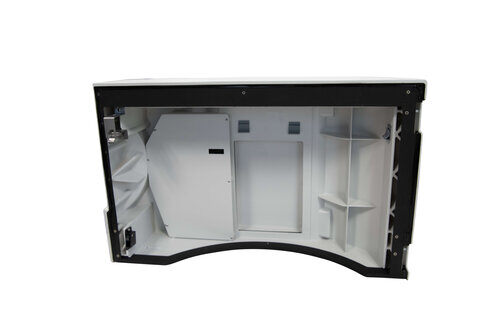
Defense contractors face a frustrating math problem. You need 500 ballistic panels. Or 2,000 protective housing components for a specialized vehicle armor system.
Traditional injection molding quotes include tooling costs, making the entire project economically unviable. The per-unit math doesn't work when you're spreading six-figure tooling investments across hundreds of parts instead of hundreds of thousands.
This is where Reaction Injection Molding changes the equation entirely.
Injection molding was engineered for scale. The process demands hardened steel tooling capable of withstanding enormous pressures and temperatures, and that tooling represents a significant capital investment. When production volumes reach tens of thousands of units, those costs amortize into negligible per-part overhead. But ballistic applications rarely operate at those volumes.
Military helmet programs might require a few thousand units. Specialty vehicle armor for law enforcement agencies often involves runs measured in hundreds. Custom protective equipment for federal contractors can drop even lower. At these volumes, injection molding's economics invert from advantage to obstacle.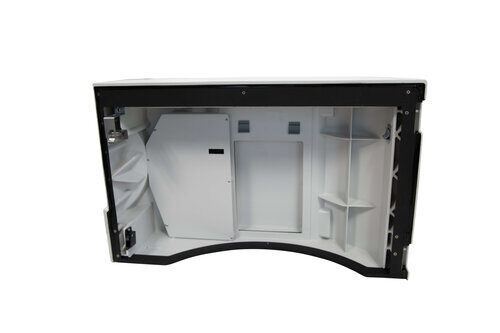
The result is a market gap. Contractors either accept prohibitive per-unit costs, compromise on design capabilities, or abandon molded solutions altogether in favor of fabricated alternatives that introduce their own performance limitations.
Reaction Injection Molding operates on fundamentally different principles. Instead of forcing molten plastic into a mold under extreme pressure, RIM introduces two liquid polyurethane components that chemically react and cure within the mold cavity. This exothermic reaction occurs at low pressure and low temperature, which transforms the tooling requirements entirely.
RIM molds can be machined from aluminum rather than hardened steel. The practical impact on project budgets is substantial. Where an injection mold might require twelve to sixteen weeks of fabrication time, RIM tooling typically comes in at four to six weeks. That acceleration alone can determine whether a contract timeline is achievable.
For production volumes between 100 and 5,000 units annually, RIM consistently delivers lower total project costs than injection molding. The tooling investment that makes economic sense at 500,000 units becomes a barrier at 500 units. RIM removes that barrier.
Cost advantages mean nothing if the material can't meet ballistic performance requirements. This is where advanced thermoset chemistries like Poly-DCPD demonstrate their value.
Poly-DCPD maintains structural integrity across temperature extremes that would compromise other polymer systems. Where conventional polyethylene begins losing performance at around 130°F, Poly-DCPD operates reliably from -100°F to 250°F. For equipment that might deploy from arctic conditions to desert heat within the same operational cycle, this thermal stability isn't a luxury feature. It's a fundamental requirement.
The material's non-hygroscopic properties address another concern that procurement teams understand well. Aramid-based materials absorb moisture over time, and that absorption degrades ballistic performance. Equipment stored in humid conditions or exposed to saltwater environments faces progressive capability reduction. Poly-DCPD resists moisture absorption, maintaining its protective characteristics through extended deployment cycles and storage periods.
Chemical resistance extends the operational envelope further. Exposure to fuels, lubricants, cleaning solvents, and other substances common in military and law enforcement environments won't compromise the material's structural properties.
Ballistic applications frequently demand geometries that challenge conventional manufacturing. Helmet shells require compound curves. Vehicle armor panels must integrate mounting features, sensor housings, and structural reinforcements. Protective enclosures often need to accommodate electronics while maintaining ballistic integrity.
RIM accommodates wall thickness variations that injection molding cannot. A single component can transition from 0.125 inches to over an inch of thickness without the processing complications that would plague injection-molded parts. This capability enables designers to place material strategically, adding mass and protection where threats concentrate while reducing weight in lower-priority zones.
The encapsulation capability opens additional possibilities. RIM can incorporate metal reinforcements, mounting hardware, and electronic components directly into molded parts during production. Sensors, antennas, and circuit boards can be positioned within the mold and fully surrounded by protective material as it cures. The low temperatures and pressures involved won't damage sensitive electronics, and the resulting integration eliminates assembly steps while improving environmental protection.
Defense programs evolve. Threat assessments change. Field feedback identifies improvement opportunities. Requirements that seemed final during initial development often need modification once equipment enters service.
Aluminum RIM tooling accommodates these realities far more gracefully than steel injection molds. Modifications cost less and take less time. When a program needs to add a mounting feature, adjust coverage geometry, or integrate a new component, the tooling can be modified rather than replaced. This flexibility extends to variant production as well. Different configurations for different user requirements can often share core tooling with selective modifications.
For contractors managing multiple concurrent programs or responding to urgent requirements, shorter tooling lead times translate directly into competitive advantage. The ability to deliver production parts in weeks rather than months can determine which contractor wins the work.
RIM isn't the right solution for every ballistic application. If your program requires 50,000 identical parts annually with no anticipated design changes, injection molding's per-part economics will likely win. If your geometry is simple enough that thermoforming or fabrication can achieve adequate results, those approaches may cost less.
But for production volumes in the hundreds to low thousands, for geometries that demand thick sections and complex curves, for applications requiring encapsulated components or material properties that conventional injection-molded polymers can't deliver, RIM offers a manufacturing path that other processes simply cannot match.
The calculation isn't complicated. Compare total program cost including tooling, not just per-part pricing. Factor in lead time implications for your contract timeline. Evaluate whether design modifications are likely over the program lifecycle. Consider whether your geometry and performance requirements align with RIM's capabilities.
For many ballistic applications, that analysis points clearly in one direction.
Ready to evaluate RIM for your ballistic manufacturing requirements? Contact our engineering team to discuss your specific application and receive a preliminary cost assessment based on your production volumes and design parameters.
