

How to Evaluate Reaction Injection Molding Companies for Your Next Project
In today's competitive manufacturing landscape, finding the right production partner can make or...
But understanding what's possible is only half the picture. How finishing gets executed, and by whom, significantly affects the quality, cost, and timeline of your project.
RIM's liquid components flow into the mold at low pressure, faithfully reproducing the mold surface without the stress marks and flow lines that can plague injection molded parts. This means the foundation for finishing is inherently good — you're not fighting the process to achieve a quality surface.
The mold itself determines much of the surface character, and engineers should understand the tradeoffs. A textured mold — aluminum, steel, or even a well-prepared composite — creates patterns directly in the part: wood grain, leather grain, geometric patterns, or custom textures specific to your brand. These molded-in textures eliminate secondary operations and remain consistent across every part. This is the standard industrial-grade approach and it performs well across a wide range of applications.
Class A painted finishes — the kind specified for automotive body panels and visible consumer-facing enclosures — are also achievable with RIM. What engineers sometimes assume is that Class A requires an expensive polished or nickel shell mold. That's not the case. Class A surface quality is a function of proper part prep, primer selection, and spray technique, not exclusively the mold surface. That said, Class A finishing does carry a cost premium over standard industrial-grade textured surfaces. When it's specified, it should be specified with purpose — for surfaces that are visible, exposed, and require that level of appearance quality.
For painted surfaces, RIM polyurethane accepts coatings exceptionally well. The chemistry creates a natural affinity for polyurethane and epoxy primers, producing strong adhesion without extensive surface preparation. Automotive-quality basecoat, topcoat, and clearcoat systems all work effectively on RIM substrates.
Multi-color finishes are straightforward with proper masking. Parts can incorporate different colors on different surfaces, accent colors on raised features, or graduated color schemes. Graphics, branding, text, and technical markings can be applied as well. Silk-screening is one established method — but modern transfer images have become a practical alternative. A transfer image delivers a silk-screened-looking result without the cost of screens, inks, and setup. For lower volumes or designs requiring frequent changes, that's a meaningful difference in both budget and lead time.
For electronic enclosures and housings that require electromagnetic protection, EMI/RFI shielding is applied by spray painting conductive coatings onto interior surfaces before final assembly. This is the same spray process used for other finishing operations, which means it integrates naturally into an in-house finishing workflow rather than requiring a separate vendor or specialized handling.
RIM formulations can now also incorporate X-ray attenuation properties, making the process viable for shielding applications in medical imaging, diagnostic equipment, and radiation-controlled environments. This is a material-level capability built into the polyurethane formulation itself — not a coating — which means the protection is integral to the part rather than dependent on a surface treatment that could wear or be damaged.
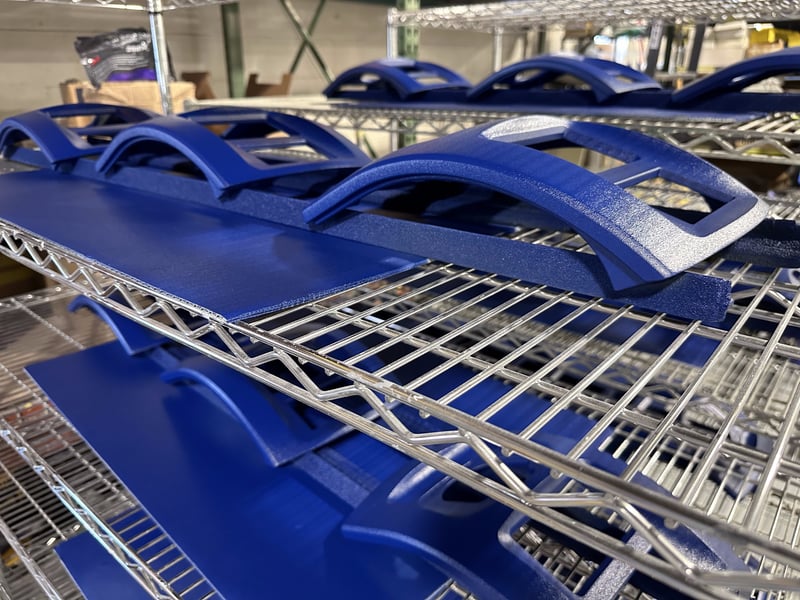
Engineers familiar with RIM may have encountered in-mold coating as an option. This technique sprays a coating onto the mold surface before the polyurethane is injected. The coating partially cures, and when the main shot fills the mold, it bonds permanently to the coating. The part emerges with its finished surface already applied.
In-mold coating works well for parts with relatively simple geometry — large panels without complex details or deep recesses. The coating must cover the mold surface evenly and remain in place during injection, which limits how intricate the part shape can be. For straightforward geometries, in-mold coating reduces secondary operations and can lower total finishing cost.
Post-mold painting offers more flexibility. Complex parts with multiple surfaces, tight radii, and varying geometry are easier to finish after molding, when the painter can address each area appropriately. Post-mold painting also accommodates color changes, running the same molded parts in different colors for different customers or product variants.
The choice between these approaches depends on your part geometry, volume, and color requirements. Simple parts in a single color favor in-mold coating. Complex parts or those requiring color flexibility favor post-mold painting.
Many RIM manufacturers mold parts and ship them to a separate finishing house for painting. This adds handling, transportation, and coordination between two organizations — and it introduces risk at every handoff.
RIM parts are durable but not indestructible. Every time a part gets moved, loaded, shipped, unloaded, and staged, there's potential for handling damage — scratches, chips, and dings that require repair before painting or cause rejection after painting. Parts that arrive at the paint house with damage become someone else's problem to solve, often with disagreement about when the damage occurred.
Quality control splits between organizations as well. The molder controls the substrate quality. The paint house controls the finish quality. When something goes wrong with the painted part, determining root cause requires coordination between two companies with different perspectives and different interests.
Single-source responsibility eliminates these problems. When the same facility molds and finishes the part, there's no ambiguity about accountability. Handling between operations is minimized. Quality standards apply consistently from raw material to finished product.
Lead times compress as well. Shipping parts to an outside finisher and waiting for their production schedule adds weeks to your timeline. In-house finishing moves parts directly from demolding to paint preparation to the spray booth, with no transportation delays or queue time at an outside vendor.
When defining finishing requirements for a RIM part, a few decisions made early have disproportionate impact on cost and execution. The most important is identifying which surfaces are visible in the final assembly. Class A finishing on every surface costs more than finishing only the faces that will be seen. Calling out show surfaces versus hidden surfaces in your initial specification helps optimize cost without compromising appearance.
Consider what the part interfaces with. If your RIM part sits adjacent to painted metal, machined aluminum, or other finished components, color matching becomes critical. Provide physical samples of adjacent materials rather than relying on color codes alone. Paint appearance varies with substrate, lighting, and application method — a sample ensures everyone is calibrating to the same target.
Environment matters too. Outdoor exposure requires UV-stable coatings to prevent fading and chalking. Chemical exposure may demand specific coating chemistries. High-wear areas might benefit from harder, more abrasion-resistant finishes than low-contact surfaces. For medical or industrial imaging applications where X-ray shielding is needed, that requirement should be captured in the material specification — not treated as a post-mold add-on.
Marking and branding requirements need early planning as well. Raised lettering or logos can be molded into the part and painted in contrasting colors. Graphics that previously required silk-screen setup can now be applied as transfer images with equivalent visual results and significantly lower setup cost — a practical option for programs with shorter runs or evolving brand standards.
Surface finishing isn't an afterthought or a commodity service. It's integral to how your product looks, functions, and holds up over time. The quality of finishing directly affects customer perception, and finishing problems are among the most visible failures a product can have.
When evaluating manufacturing partners for RIM projects, ask about their finishing capabilities with the same rigor you'd apply to their molding capabilities. Understanding whether finishing happens in-house, what equipment they use, and how they control quality tells you a lot about what the final parts will look like when they arrive at your dock.