
Why Traditional Ballistic Materials Are Holding Back Your Armor Design
Engineers designing ballistic protection systems face an impossible tradeoff: choose aramid fabrics...
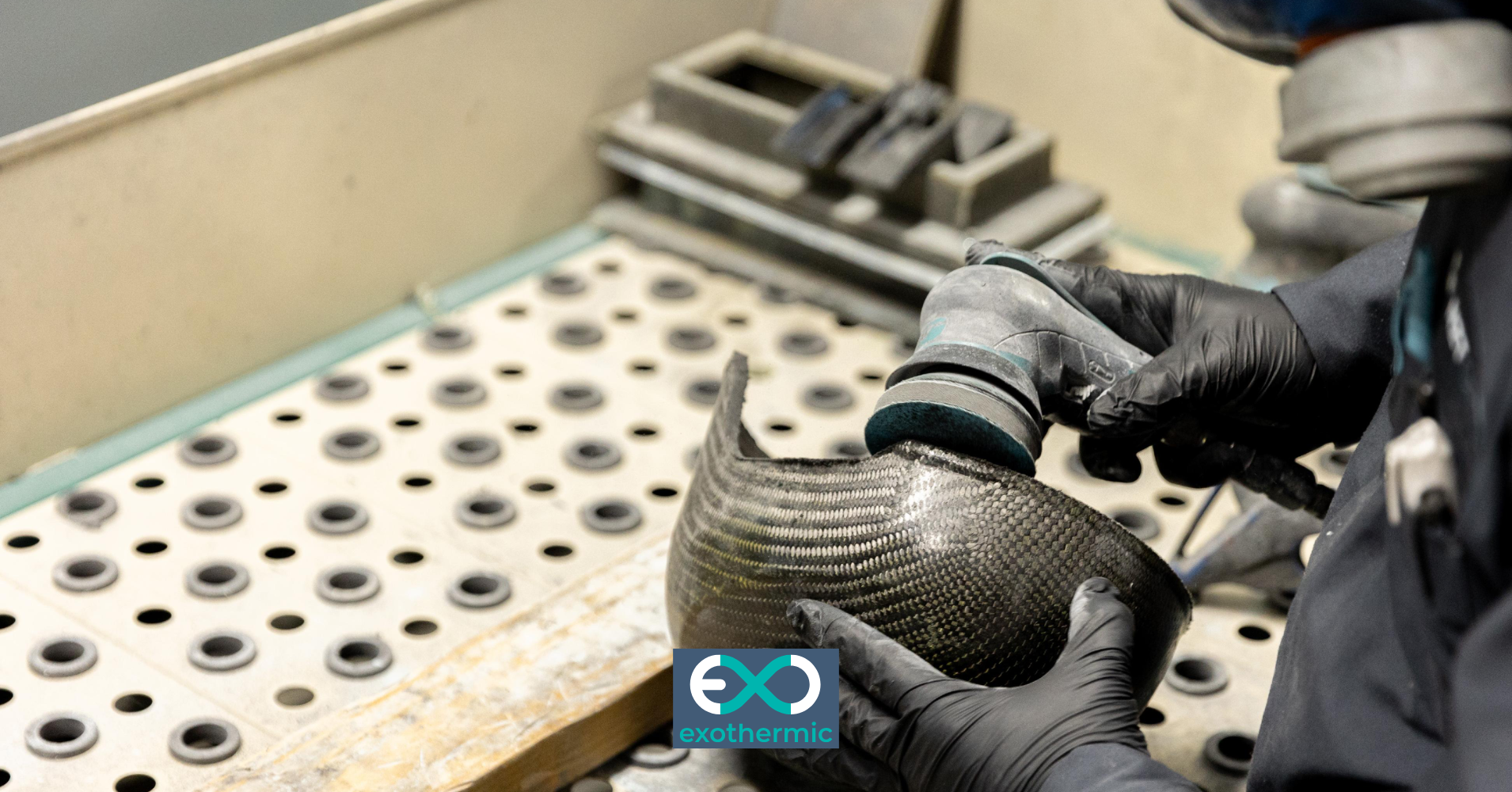
Most ballistic upgrade programs stall on the same tradeoff: more protection means more weight. A Poly-DCPD composite molded by reaction injection breaks that tradeoff, but only if you specify, test, and source it correctly.
The materials that saved lives for the last 40 years are fiber-based. Aramids like Kevlar® and Twaron® catch a projectile through yarn slippage and fiber stretch. Ultra-high-molecular-weight polyethylene (UHMWPE) does something similar at lower density. Both work by absorbing energy inward, toward the wearer.
NEOZANT™ takes a different path. It is a thermoset built on ring-opening metathesis polymerization (ROMP), the chemistry recognized with the 2005 Nobel Prize, and it belongs to the Poly-DCPD family we already mold for industrial and medical customers. Combined with carbon fiber, and in some configurations ceramic, it disperses impact energy laterally across the panel instead of driving it toward the body. Extremis Systems, which developed the material, reports that this outward dissipation lowers backface deformation and improves multi-hit performance because the energy of one strike is spread across a wider area rather than concentrated at the impact point.
We are the authorized molder and distributor for NEOZANT™ in RIM applications. Stuart Toner at Extremis put it this way during our joint webinar: the weight penalty, the environmental sensitivity, and the geometry limits of current armor are artifacts of old materials and old processes, not laws of physics.
Every figure below comes from Extremis Systems test data or from Stuart Toner's statements in our webinar, except where a standard is cited.
| Property | Aramid (Kevlar®, Twaron®) | UHMWPE | Steel / ceramic plate | NEOZANT™ Poly-DCPD composite |
|---|---|---|---|---|
| Strength by weight (NIJ 0106.01 BFD) | Baseline | Baseline | Not comparable | 260% of aramid / UHMWPE baseline |
| Upper service temperature | Reasonable range | Begins losing integrity near 130°F | High | 250°F |
| Lower service temperature | Reasonable range | Reasonable range | High | -100°F |
| Moisture | Hygroscopic, 15-20% performance loss in humid conditions | Low absorption | Steel corrodes | Non-hygroscopic, validated after saltwater immersion under DEA/FBI Protocol 2024 |
| Multi-hit behavior | Good | Deforms after first impact | Ceramic cracks, fracture spreads to adjacent area | Stays intact, no fragmentation |
| Weight vs. steel at equivalent protection | Lighter | Lighter | Baseline | 62% lighter |
| Geometry | Woven, fights compound curves | Thermoformed or compressed sheet | Flat or simple curve | Molded to any contour the tool allows |
The temperature column matters more than it looks. A vehicle interior parked in direct sun or a shipping container crossing the equator will pass 130°F. Polyethylene softens there. Poly-DCPD does not change behavior until well past 250°F, and its glass transition temperature exceeds 270°F (Element Labs ESM Resin Systems User Guide).
This is where our process changes the design conversation. Aramid and polyethylene arrive as fabric or sheet. Protection thickness is whatever the layup gives you, uniform across the part, and every mounting point or cable pass-through is a hole cut after the fact. Each hole is a gap in the ballistic envelope.
We fill a mold with liquid resin at atmospheric pressure. The pressure that packs the part builds from the chemical reaction itself as the material cures, not from applied injection force. The resin flows into every detail before it sets, which means the thickness can run from 0.125 inch to over 1 inch within a single component (Exothermic process data). Paul Steck describes the design rule simply: put the protection where the threat analysis says the threat is, and take it out where it is not. Bosses, rails, and mounting features mold in as part of the same continuous shot. Nothing is drilled through the armor. We have also encapsulated electronics and sensors directly inside molded structures on non-ballistic programs, and the same technique applies here.
The resin's low viscosity, which Paul compares to water, is what makes this practical. He estimates infusion of a large component runs about 10 times faster than with an epoxy system, and there is no autoclave and no hydraulic press in the loop.
If you have specified armor by "Level IIIA" or "Level IV," the vocabulary changed. In November 2023 the National Institute of Justice published two linked standards: NIJ Standard 0101.07 for ballistic resistance of body armor, which supersedes 0101.06, and NIJ Standard 0123.00, which separates protection levels and test threats into a standalone document so NIJ can update threats without rewriting every equipment standard (Federal Register, 2023-26327). Prior versions of NIJ standards for body armor, helmets, and materials each included their own protection levels, and the threats often differed across documents.
The crosswalk under NIJ 0123.00:
| Former level | New level | Representative test threat (reference velocity) |
|---|---|---|
| Level II | HG1 | 9mm FMJ RN 124 gr at 1305 ft/s; .357 Mag JSP 158 gr at 1430 ft/s |
| Level IIIA | HG2 | 9mm FMJ RN 124 gr at 1470 ft/s; .44 Mag JHP 240 gr at 1430 ft/s |
| Level III | RF1 | 7.62x51mm M80 at 2780 ft/s; 7.62x39mm MSC at 2400 ft/s; 5.56mm M193 at 3250 ft/s |
| None | RF2 | All RF1 threats plus 5.56mm M855 at 3115 ft/s |
| Level IV | RF3 | .30-06 M2 AP at 2880 ft/s |
Source: NIJ Standard 0123.00, Tables 1 through 3, including Addendum 1 (November 2024), which revised M80 mass to 149 +0/-3 grain.
Helmets still test under NIJ Standard 0106.01, and NIJ expects future revisions of its helmet and shield standards to reference 0123.00 as well. Write your solicitation in the new nomenclature now so it does not need a revision when that happens.
Ask for the lab report, not the data sheet summary. The Extremis Athena helmet report from SMS Testing in Rising Sun, Maryland is a useful model of what a complete report looks like. Testing followed NIJ 0106.01 (modified) with the barrel 17.2 feet from a clay-backed NIJ head form, five shots per sample at 0-degree obliquity, velocity measured by four infrared screens. The 9mm sample (2.94 lb) took five rounds between 1360 and 1446 ft/s with zero penetrations and backface deformation from 8.1 to 15.1 mm. The .357 Magnum sample ran 14.9 to 18.9 mm. The .44 Magnum sample ran 19.4 to 27.4 mm, all with zero penetrations (SMS Testing report, December 20, 2023). The production Athena weighs 2.73 lb fully dressed in L/XL high cut (Extremis Systems data sheet).
Two things worth noticing. First, that report carries a disclaimer that it cannot be used to claim certification or endorsement by NVLAP, NIST, or any federal agency. That is standard language, and any supplier who tells you a lab report equals certification has skipped a step. Certification comes through a conformity program such as the NIJ Compliance Testing Program, on a specific model, not on a material. Second, the report lists ammunition lot, powder, barrel, temperature, and humidity. If a competing report leaves those out, ask why.
For environmental qualification, Extremis validated the composite under DEA/FBI Protocol 2024 including saltwater immersion. Ask any material supplier for accelerated aging data as well. Stuart reports minimal property degradation across projected service life, with none of the moisture or UV sensitivity that drives aramid replacement cycles.
The questions we would want asked of us:
What is your quality system, and can you prove lot traceability on the resin? We are ISO 9001:2015 certified and maintain full lot traceability on materials, process documentation, and inspection records for every defense program.
Who owns the tool, and what happens to it if the program moves? You own it. We have been transferring and refurbishing RIM tooling for other molders' customers for decades, and we expect the same courtesy to run in reverse.
How fast can you give me a number? Send a rough sketch or CAD and we return a budgetary estimate within a week, enough to decide whether the program is worth serious engineering time before anyone cuts steel.
What is the material supply picture? NEOZANT™ is manufactured specifically for these applications and does not compete with commodity resin markets. Stuart quotes lead times in weeks, not months, and Extremis sets up inventory agreements matched to production schedules on established programs.
Does the cost pencil out? Paul's estimate from our program work is that total program cost, tooling plus production plus assembly savings, runs 15-30% below a traditional aramid or ceramic approach. That figure does not count the downstream value of weight removed from a vehicle or a soldier.
Defense programs rarely start at full rate. In our experience, several have begun at a few hundred units and grown to several thousand. RIM handles that curve better than injection molding or compression molding because we can build the tool for initial volume and add cavity count as the schedule firms up. First article inspection follows within two weeks of tool completion, and design iterations take weeks rather than the six to nine months Paul sees in traditional ballistic development. Because baseline material data already exists for NEOZANT™, we can project ballistic performance before cutting a mold rather than starting from zero.
No material is. Certification applies to a finished product model tested under a conformity program. The composite has been tested under NIJ 0106.01 (modified) by SMS Testing and validated under DEA/FBI Protocol 2024.
Yes, if program constraints require it. You will leave capability on the table. A redesign that uses variable wall thickness and molded-in features gets the full weight benefit.
Low to mid volume programs where tooling for injection molding or compression molding cannot be justified.
-100°F to 250°F per Extremis Systems testing.
Either. The first technical conversation is a three-way call with both of us and your engineers, at no cost.
Send us your threat level in NIJ 0123.00 nomenclature, the geometry, and the target weight, and we will tell you within a week whether a molded Poly-DCPD component gets you there. Exothermic has been molding complex low-volume parts by reaction injection since 1971.
