
At What Volume Does RIM Make More Sense Than Injection Molding?
If you are running between 100 and 5,000 parts a year, reaction injection molding almost always...
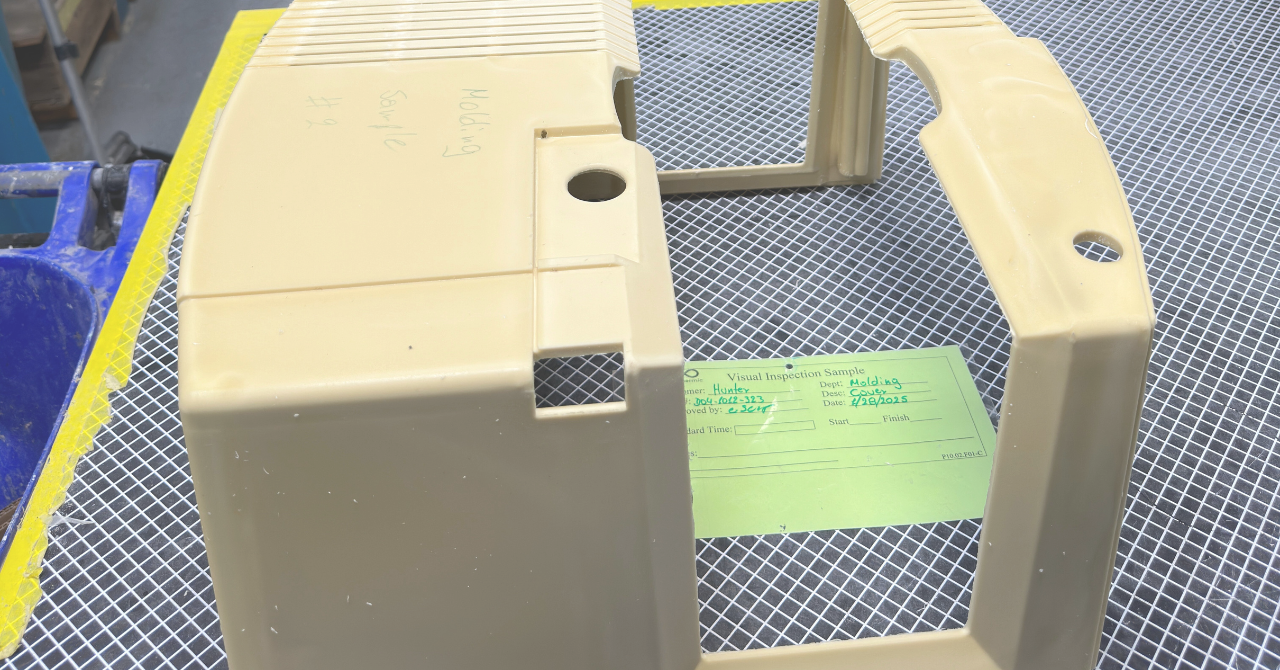
There is no size ceiling written into RIM chemistry. The limit is equipment, and it is a much higher limit than most engineers expect.
Quick Answer: Reaction injection molding has no upper part size limit other than equipment capability, per the Covestro RIM Part and Mold Design Guide. Practical limits come from metering machine capacity, clamping arrangement, and gel time. Our free-standing hand-clamped molds handle parts up to 1,000 lbs. Published RIM parts include single panels measuring 87 by 67 inches and one-piece shields 6 feet square.
RIM carries no upper part size limit other than equipment capability. The design guidance we work from states that plainly, and notes that parts heavier than 100 lbs have been produced. Bigger than the part you are holding, in other words.
We work at the top of that range routinely. A free-standing, hand-clamped mold in our shop handles finished parts made from P-DCPD up to 1,000 lbs. Published data on the Poly-DCPD systems we run describes parts of nearly that weight, with walls varying from 0.75 inch to 5 inches, demolded in under an hour.
If your part is under a few hundred pounds, size is not the question you should be asking us. Geometry and volume are.
Three things set the practical size limit on a RIM part: metering machine capacity, clamping arrangement, and gel time. The chemistry itself imposes no ceiling.
Metering machine capacity. The machine has to deliver enough material fast enough to fill the cavity before the resin gels.
Clamping. RIM molds see internal pressure around 50 psi. The clamping arrangement only has to exceed that across the projected area of the part, so a large flat panel needs surprisingly little force compared with what injection molding would demand.
Gel and cream time. The resin starts reacting the moment it mixes. A very long flow path can outrun the chemistry. This is a mold design problem, solved with gate placement and flow splitters rather than a bigger machine.
| Part | Size | Weight |
|---|---|---|
| Computer tomograph rear panel, Thieme Corporation | 87" x 67" | 74 lbs |
| Combine outer shell panel, CNH Global AFX series | 101" x 76" | Not published |
| One-piece combine rear shield, Deere & Company | 6 ft x 6 ft | 56 lbs |
| Wind turbine blade half, U.S. Department of Energy program | 24 ft long, tapering 40" to 9" | Assembly over 300 lbs |
The Thieme panel is described in our published design material as one of the largest known single-shot RIM parts ever molded. The enclosure it belongs to uses only 12 panels and is rigid enough to be picked up and moved after assembly, which is the part of the story that matters. Molded-in ribbing let the panel act as its own support structure while still finishing as a show surface.
RIM handles large parts better than injection molding because of viscosity. The two liquid components run between 500 and 1,500 centipoise, thin enough that shot times vary depending on material; 5-7 seconds for urethane is typical.
Injection molding fills a cavity with molten thermoplastic against far higher resistance, which means press tonnage scaled to the projected area of the part. Double the panel size and the press requirement grows with it, until no available press will hold the tool closed. RIM never runs into that wall in the same way.
The second reason is structural. Polyurethane and Poly-DCPD parts can carry molded-in ribs deep enough to make a large panel self-supporting, so a single RIM shot can replace an assembly that injection molding would build from several pieces plus fasteners.
The smallest practical RIM part is around half a pound. Metering machine capability puts the minimum shot near 0.5 lbs, roughly 225 grams, which corresponds to about a 6-inch square at 3/8-inch thickness.
Below that, gating and aftermixer waste is a larger fraction of the shot than the part itself. Specialty small-part machines exist. For some programs, a part that small belongs in another process, and we will say so.
Often, we can make small parts economically by combining them into a multi-cavity mold.
A large RIM part is worth evaluating for a split at around 50 lbs. Design guidance suggests considering redesign into smaller components for later assembly past that weight, mostly because of press-size and handling limits downstream.
We do not treat that as a rule. We have run heavier single parts, and one-piece is often the whole reason a customer came to RIM. The useful version of the question is whether a two-piece design saves more in handling and tooling than it costs in bonding labor and a new failure point at the joint. For modular designs, two or more components of one assembly can sometimes come out of the same mold.
No, other than equipment capability.
Parts up to 1,000 lbs.
About 0.5 lbs, or 225 grams.
From 0.125 inch to over 1 inch within a single part. Poly-DCPD sections up to 5 inches thick mold successfully. We can mold thinner if UL94 flame retardant rating approval is not required.
Often not. Many large RIM molds are free-standing and hand-clamped if using P-DCPD resins. Urethane requires a press.
Send us the envelope dimensions and a rough weight and we will tell you the same day whether it fits our equipment. Exothermic has been molding large RIM parts in New Jersey since 1971.
